See how verification works from meeting to follow-through.
This fictional example demonstrates the intended Groundnote workflow without implying a customer result. Interface labels and availability can vary by product version and deployment configuration.
Scenario
A six-person product review discusses whether to delay a release until a security check is complete. The meeting contains a proposal, a conditional decision, one named action, and an unresolved risk.
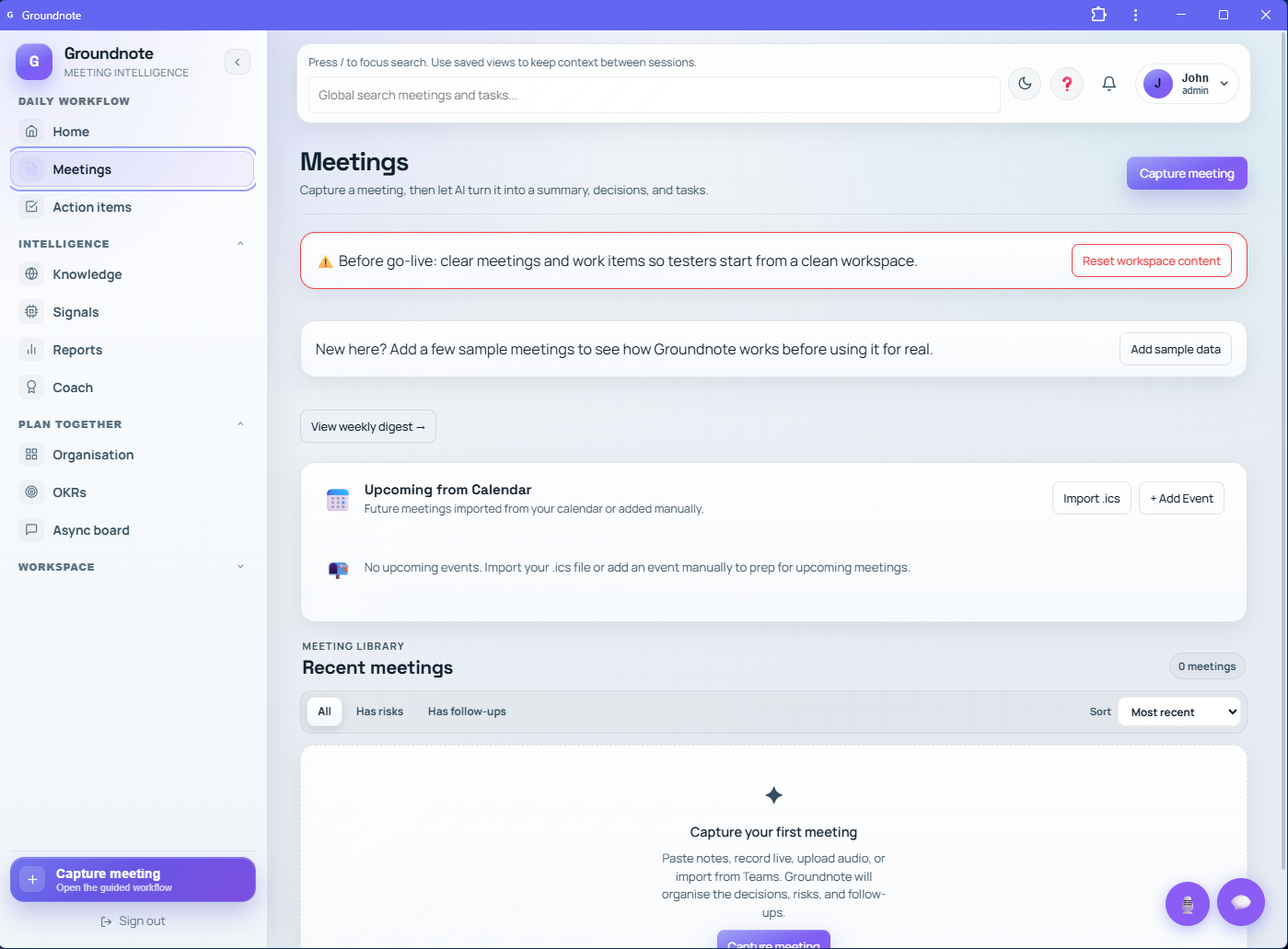
Walk through the workflow
1. Capture the meeting input
The team starts from a recording, uploaded media file, pasted transcript, or configured meeting connection. The capture method and processing path remain relevant because external services may create different data flows.
2. Structure candidate outcomes
“Move the release to 18 September, subject to completion of the security review.”
“James to complete the security review by 11 September.”
These are candidates, not accepted facts. The system keeps the decision, commitment, and risk distinct.
3. Inspect source evidence
A reviewer opens the relevant transcript passage and surrounding context. They verify that the launch date was agreed, preserve the security condition, and confirm that the action was addressed to James rather than inferred from who spoke most often.
4. Confirm or correct ownership
James can accept, correct, or dispute the commitment and date. Acceptance changes the record from inferred to confirmed; a correction or dispute remains visible instead of silently replacing the earlier state.
5. Connect execution
The reviewed action can be sent to a supported work tracker. The external issue reference is stored with the Groundnote record, subject to the connector's documented direction and limitations.
6. Resurface unresolved work
At the next relevant review, the security risk and action return with their current state. If leadership changes the launch decision, the new record links to the superseded decision so the history remains understandable.
What this demonstrates
- AI extraction is separated from human confirmation.
- Consequential claims stay connected to source context.
- Conditions are preserved with the decision.
- Ownership is accepted rather than merely assigned.
- Later changes and unresolved work remain reviewable.
Published and reviewed 4 September 2026. This is a fictional product demonstration, not a testimonial, benchmark, or promise of a particular organisational outcome.